Dustykid AI
Dustykid is a Hong Kong wellness brand with over a million followers. I led the frontend and stepped in on UI and UX, taking each design from v0 to live.
- Year
- 2025 – 2026
- Role
- Lead frontend developer
- Platforms
- Student web app and school admin platform
- Stack
- React · Next.js · TypeScript · OpenAI
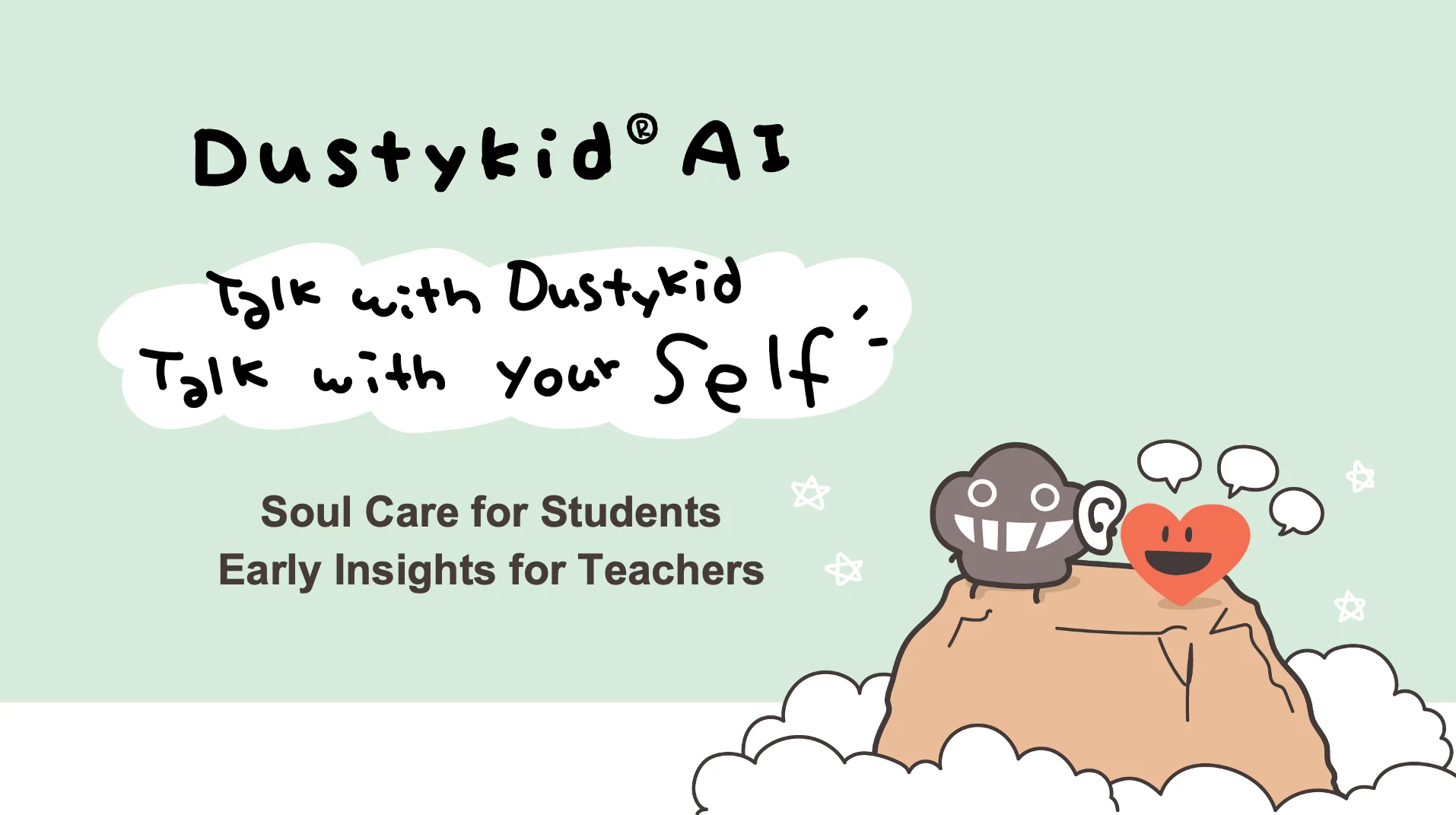 Dustykid AI's launch banner – uk.dustykid.com ↗
The brief
Dustykid AI partnered with HKUST to give students a place to say the thing they can't say out loud, and schools the tools to support them.
A space students trust
Students who are struggling rarely say so first. I knew that before the project started. I used to teach piano, and one of my students was a Hong Kong kid, hardworking and shy, who opened up less than most kids I taught. I kept that student in mind through the build: the app had to feel private and unhurried before anything else, so a student would keep typing.
Three languages, one voice
English, Traditional Chinese and Simplified Chinese, each with its own typography and copy rhythm. I built the languages into the components from the start instead of translating the screens afterwards.
The turn
I believed
A designer would hand me the finished product and I would build it. Design was someone else's job and code was mine.
What happened
The team had a graphic designer rather than a product designer, so what I received was the brand and a still frame for each page. Everything that only shows up once someone actually uses the app – the mobile layouts, the confirm dialogs, the edit and delete views – was mine to work out. I worked each one through with the stakeholders as I went, proposing on a phone screen what it should do, and several of them went in the way I proposed them.
What changed
I took on the UI and UX for the whole interface, alongside the frontend. I built the missing pieces on shadcn primitives and reskinned them to the brand, so the designer's look held and the code stayed something a team could maintain after me. I wasn't hired for that part, and it has been part of how I work ever since.
Decisions
The interface was the part I owned: a student app and a school platform, in three languages, on phones and on desktops.
AI chat
The screen a student actually lives in. I built it to stay calm and unhurried whatever hour it gets opened, with settings so a student can make the space their own.
School management platform
The staff side. One platform, and every role from administrator down to student sees a different product inside it. I built the role-based views, class and people management and the school dashboard, and the access layer that decides what each role can reach.
Editor gallery platform
Also teacher-facing, for the same people as the platform above. Educators choose the illustrations a student sees, in all three languages, and I built the tool they manage them with.
Impact
Piloted in schools and organisations, then publicly launched in October 2025.
Winner of the Global EdTech Startup Awards, representing Hong Kong at the 2026 world finals.
MVP1 shipped on time, in three languages, on both surfaces.
Jun is incredibly easy to work with. Over the past few years, what I've valued most is how thoughtful she is and how much she cares about getting the product details right. She doesn't just build to spec, she'll flag UI/UX suggestions that catch things we'd missed, and if she spots a better approach, she'll talk it through rather than just closing the ticket.
She thinks about the whole product and the user experience, not just her own scope. That makes scoping and implementation chats quick, and the whole collaboration a lot smoother.
Reflection
Building for mental health taught me to think beyond “does it work”. Small details matter: how a message is worded, what a teacher can see and what stays private. I'm slower now to ship a UI decision without asking who it actually touches.
I worked directly with the stakeholders, backend engineers and the illustration designer through the whole build, including UI and UX. I'm quicker now to ask who reads this screen, and when.
Differently, today
I'd default to Traditional Chinese, and stop leaving language in settings with no onboarding. We shipped three languages and I still gave Hong Kong students an English screen to open. Getting the language right on the first screen matters more than having all three.
More projects